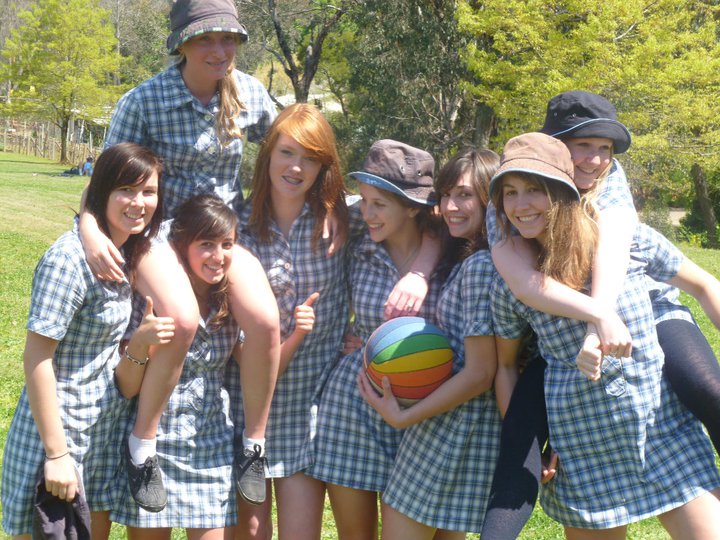
In August it is time again to welcome numerous students from all over the world who will spend an exciting High School Year in Germany with DFSR. They will live with a German host family and experience the German school life which will be completely different to what they are used to. To give all our students an impression of how school life in Germany looks like, two 15-year-old German girls are writing about their daily routine.
One of them, Paula, visits the Sixth Form of a comprehensive school and Chiara visits the 9th grade of a secondary school only for girls.
Paula wrote, what a day as an eleventh grader at a comprehensive school is like for her:
There are three school branches you can go to in Germany. The best degree you can get is the one you get at “Gymnasium”. You can compare this to the British A-Levels. In some parts of Germany you go to Gymnasium for 13 years but in others there is a new system called G8, which says that you only go to Gymnasium for eight years, plus the four you go to primary school, so altogether twelve years. But lots of students, parents and teachers complained about G8 because it is way harder when you have a year less than you had before, so it looks like it is going to be removed again. Unluckily I was the second year to have G8, so now I am in eleventh grade, even though I have only been going to school for ten years. After nine years at Gymnasium you move on to Sixth Form. Before G8 you did that after ten years, so I skipped tenth grade.
I usually get up at 6:40am and I’m late every day but I’m always too tired to get up earlier because as you know, there are things that are way more important than sleeping! My friends pick me up at about 7:20am, which is a little too early, because the bus comes at 7:30am and we only need about a minute or two to get to the bus stop but we always find things to talk about, since we’re girls. Then we arrive at school at about 7:50am and have five minutes left to get to our class room before the first lesson starts. One lesson goes on for 45 minutes and we have breaks of five minutes between every lesson and breaks of 15 minutes between every second lesson. A normal school day ends after six lessons at 1:10pm. If we have lessons in the afternoon, school usually ends at 3:30pm and there is a lunch break between 1:10pm and 2:00pm.
For lunch we have a cafeteria. You can either buy a coupon for a whole varying meal in the morning or you buy something from the usual offer at lunch time, which contains sausages, sandwiches, sweets and lots more. There is even "Schnitzel" in a bun, but you can also bring your own food of course.
But before we can get lunch we have to go to class. It depends on the teacher whether it is strict or not and whether there is a lot of talking in class. At my school there is a room where students go, if the teacher cannot handle their bad behavior anymore. The students at my grade are all grown enough not be sent there but a few of the younger ones visit it from time to time.
Now that I am in Sixth Form everything is a lot harder than it was before. Also the grades are different from the ones in middle school. Usually we get grades from one to six and one is the best, just like the grades from A to F. Now we get grades from one point to 15 points and 15 is the best. Everyone in my class got really bad grades at first when they got to Sixth Form because it is so much harder. I did as well but I could not complain, it was fine compared to some of the others. But the good thing about Sixth Form is that you are allowed to do more things than the younger students. In the breaks we can go wherever we like without a teacher around us. We have our own room to go to and nobody ever cares if we use our phones in the break, even though it is forbidden.
Actually phones are used quite often, even in the lesson but you should try not to get caught. Some teachers are really strict about that but some of mine even use it for some fun exercises in the lesson but I guess they are exceptions.
The teachers always try to make the lesson as exciting as possible for the students. Some are actually good at that, some are less. I like most of my teachers. Of course there are some I would replace but all in all I was pretty lucky. Most of the time we just have a topic that we do for a few weeks and then we get worksheets or work with the book we have for every subject. Sometimes we have to prepare presentations but I guess that is all pretty ordinary.
There are a lot of extracurricular activities to choose from at my school and younger students actually have to pick one or more to collect points. They need a special amount of points until they reach eighth grade. I was lucky because I joined the school band when I was in sixth grade, so I easily got all the points in time. Apart from school band there are also things like football, volleyball and extra classes for some subjects but also unusual things like archery or LEGO robotics. The extracurricular activities always take place in the eighth and ninth lesson, so they go on until 3:30pm, just like the normal classes do some days. Of course you can only choose an activity that does not take place on a day you have classes at that time anyway.
At my school in Sixth Form nobody really chooses any extracurricular activities anymore because you have lessons in the afternoon at least three times a week anyway. But you have to choose from Music, Arts and Drama. You can only pick one and they always take place in the eighth and ninth lesson, just like all the extracurricular activities. I chose Drama which is so much fun. Soon there will be an evening where we have to perform plays that we thought of ourselves in groups and I cannot wait for it.
After what we call a long school day it is very exhausting to do your homework, which has gotten more since I am in grade eleven. Depending on how long the time between two lessons of one subject is, the teachers give us smaller or bigger exercises to do at home. Some are easy to do, for example when you like the subject or the teacher thought of a cool thing to do, but some take a long time to do and you feel like you never really get the right solution, like me when I try to do my Math homework.
My favorite subjects are probably English, Sports and Drama. But I am a total zero at Math and the scientific subjects and I don't like them at all. I can get rid of three subjects by the end of this school year but sadly I am not allowed to get rid of Math, so I will probably say goodbye to Chemistry, Physics and one more subject that I am not sure about yet.
 |
| School Building |
Here's what Chiara's day looks like:
My school is a school only for girls. It´s catholic and has a church next to it, so Religion is very important there. I usually get up at 6 am and my train is coming at 7.14am. Them I´m in school at 7.30am and I talk to my friends until the teacher arrives. When the teacher is there we greet each other and then we pray to God before we start the lesson. Our class rooms look very different: from very tidied up to…messy like ours. But that depends on the class that owns the room.
We have many different lessons which is usual on a day but in some we have the same teacher for example in Math and Physics which can be a bit annoying sometimes. Some teachers are very funny (or they think they are) but there are also very strict teachers.The best lessons (in my opinion) are English (because it´s my favorite language), Biology (it depends on the topic) and History (I love the lesson but I don´t get along with the teacher very well, so at the moment I´m not so enthusiastic with it).
In the 8th grade we´ve decided if we want to learn a third language and I did so I have English, French and Spanish. Natural sciences aren´t my best lessons but sometimes it´s exciting to do an interesting experiment, so sometimes it´s not that bad. Math is veeery exhausting most of the time, not only because of the subject but also because we only have it in the later lessons, so we´re always loud and the teacher is annoyed…
Sports is usually quite good: This year, our first topic was dancing and creating a choreography. That was fun and varied. Then we had soccer which was not so good and now we had a little excursus in hockey which was very funny but a little bit painful.
In the ninth grade you may go to the city during the lunch break but when you´re younger you have to stay in the cafeteria and eat there or bring your own food. Only the senior classes may stay in the class rooms but because of a building lot everyone stays in because there´s not so much space for all of us.
Cell phones are forbidden but many students use them during the lessons anyways.
On special days for example the last day before the Christmas holidays we have to go to church.
And at 1.35am, the end of the 7th lesson, my shortest school day ends and at 3.15am the end of the 9th lesson my longest ends but I usually have to wait for my train.
After school I have to do the homework if it´s given and sometimes it takes pretty much time because we have to write long texts. Then I also have to learn for the exams which are at most 3 in a week.
But there are also activities like Chemistry club, Dancing, Theatre, Orchestra or Singing after school. Then at the end of the school year our Theatre and the Singing Groups have a show in the “Stadttheater”, the theatre of the city Bensheim. Also the orchestra has a show in the theatre and the girls who dance participate in a competition.
We hope you can imagine German school lifes better now and that it sounds interesting to you.If you are
interested in spending a High School year in Germany, have a look at http://www.dfsr.org/en_english/highschool_germany.htm